Today, Goan tutti-frutti is often dismissed as a brightly coloured bakery addition—industrial, artificial, and far removed from tradition. This perception, however, obscures a far older story. Candying fruit was never about colour or novelty; it was about preservation, control of moisture, and the intelligent use of sugar long before refrigeration existed.
To understand Indian tutti frutti is to understand how culinary technique travels while ingredients change.
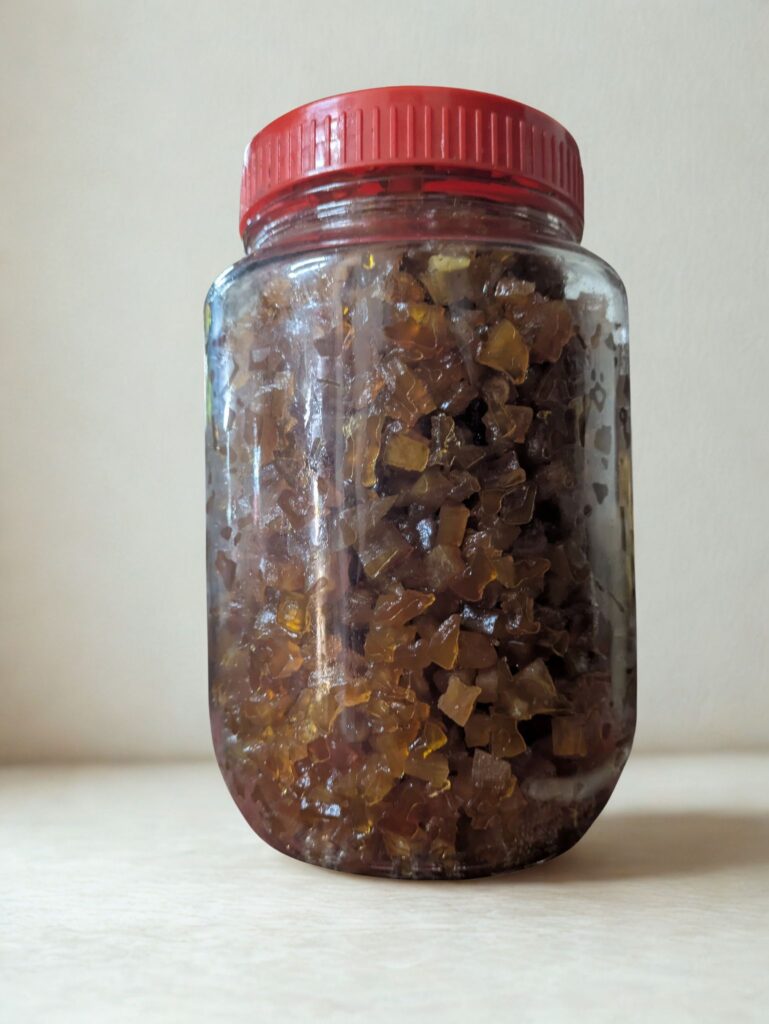
Candying Fruit: Preservation Before Pleasure
The preservation of fruit using sweeteners predates refined sugar. Ancient civilizations used honey to extend the life of fruit, exploiting its ability to inhibit microbial growth. With the wider availability of sugar in Europe during the late medieval period (14th century onward), candying developed into a formalised technique.
Fruit was gradually cooked or steeped in increasingly concentrated sugar syrups until its internal water was replaced by sugar.
This achieved three essential outcomes:
- Reduced water activity, limiting microbial growth
- Stabilisation of colour and structure, slowing oxidation
- Extended shelf life, allowing fruit to be stored for months
Candying, therefore, functioned as a preservation technology long before it became a confectionery art.
“Tutti Frutti”: A Name, Not an Ingredient
The term tutti frutti originates from the Italian tutti i frutti, meaning “all fruits.” Historically, it referred not to a specific fruit or formula but to a mixture of assorted fruits, often candied or preserved.
In European baking traditions, particularly Italian and later pan-European festive cakes, tutti frutti described combinations of locally available fruits—citrus peel, cherries, apricots, plums, and raisins. The term travelled easily across borders; the fruits themselves did not.
Tutti frutti was a concept, not a recipe.
Papaya and Colonial Trade: How a New World Fruit Reached Goa
Papaya (Carica papaya) is native to the tropical Americas. It was entirely unknown in Europe before the Age of Exploration and therefore absent from medieval Italian or Spanish confectionery traditions.
Historical agricultural records indicate that papaya reached India through Portuguese maritime trade in the early 17th century, following routes that linked the Americas, Africa, and the Indian subcontinent. In Goa, papaya thrived—climatically suited, widely cultivated, and easily accessible.
This fact corrects a common misconception: papaya-based tutti-frutti is not European in origin, nor is it a degraded form of it.
Why Papaya Was Never Part of European Tutti-Frutti
Simply put, the fruit did not exist in Europe at the time. Its later presence in Indian baking reflects colonial exchange, not culinary error.
Portuguese-Goan (Luso-Goan) Christmas Cakes and the Logic of Substitution
Portuguese-Goan (Luso-Goan) Christmas cakes—bolo de Natal and later bolo-rei—depend heavily on dried and candied fruits. These cakes were designed to last through the festive season and symbolised abundance, preservation, and celebration.
In Europe, candied stone fruits and citrus peel were readily available. In Goa, they were not. Rather than abandon the technique, local baking adapted to it.
Papaya peel—firm, neutral in flavour, and capable of absorbing sugar—became the logical but innovative substitute. When candied, it replicated the texture and function of European candied fruits, even if the flavour profile differed. Over time, this substitution became standardised and embedded into local baking traditions.
This was not approximation. It was culinary problem-solving shaped by geography.
Indian/Goan Tutti Frutti: Technique Over Imitation
Portuguese Christmas cakes—bolo de Natal and later bolo-rei—depend heavily on dried and candied fruits. These cakes were designed to endure the festive season, with sugar acting as both preservative and symbol of abundance.
In Europe, stone fruits and citrus peel fulfilled this role. In Goa, they were scarce or unavailable. Rather than abandon the technique, Goan bakers adapted it.
Papaya peel—firm, neutral in flavour, and capable of absorbing sugar—became the logical substitute. When candied, it replicated the texture, function, and keeping qualities of European candied fruit, even if the flavour differed. Over time, this substitution became embedded in Luso-Goan Christmas cake traditions.
This was not compromise. It was culinary problem-solving shaped by place.
What Goan Tutti-Frutti Really Represents
Goan tutti frutti is not an industrial shortcut. It is evidence of how culinary techniques migrate while ingredients evolve; how festive foods adapt without losing their internal logic; and how preservation anchors tradition more firmly than nostalgia ever could.
To understand tutti frutti in Goa is to understand that food history is rarely fixed. It is negotiated—between land, trade, and necessity.
And sometimes, that negotiation tastes like candied papaya.
Source Notes / References
Candied fruit, Encyclopaedia Britannica / Wikipedia (historical and technical overview of candying)
Mintz, Sidney. Sweetness and Power (history of sugar and preservation)
Tutti frutti, historical linguistic usage — Italian culinary terminology
Agricultural introduction of papaya to India via Portuguese trade routes (early 17th c.)
Bolo-rei and bolo de Natal, Portuguese culinary history records

Leave a Reply